
All products are supplied strictly for laboratory and research use only. Not for human or veterinary use.
By the Premium UK Peptides Research Team · Updated October 2026
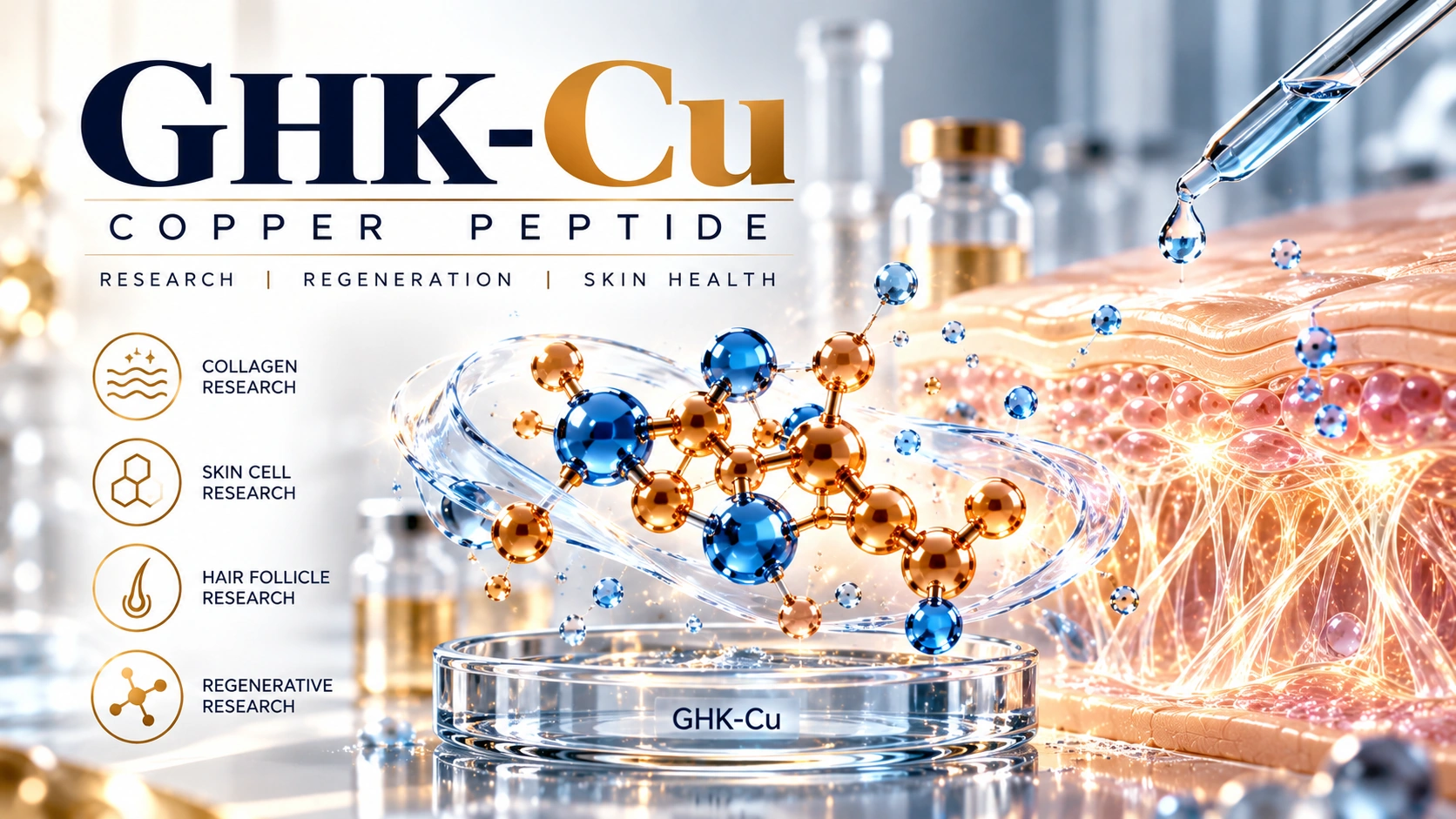
GHK-Cu is the most researched copper peptide. It is found naturally in human blood plasma, the amount drops as we get older, and scientists have studied it in skin research for decades.
In this guide we explain, in plain English, what GHK-Cu is, what scientists have actually tested, how it differs from AHK-Cu and, just as importantly, where the evidence runs out.
What Is GHK-Cu?
GHK-Cu is a tiny peptide attached to a copper atom. A peptide is simply a short chain of amino acids, the small building blocks that proteins are made from.
GHK-Cu has just three amino acids:
- G – glycine
- H – histidine
- K – lysine
That is where the name comes from. “Cu” is the chemical symbol for copper, and the peptide holds on to copper very tightly.
GHK is not man-made in origin. It occurs naturally in human blood plasma. What makes it interesting to researchers is that the amount in the body goes down with age. Published reviews describe this decline, but they do not give exact figures.
This is the main reason most GHK-Cu research focuses on skin: GHK levels fall over the same years in which skin changes with age.
What Does “Copper Peptide” Mean?
“Copper peptide” is not one single ingredient. It is a group name for any short peptide that binds to copper. Two come up again and again in research:
| Peptide | Made from | Mainly studied for |
|---|---|---|
| GHK-Cu | Glycine, histidine, lysine + copper | Skin: collagen, the skin’s support structure, wound repair |
| AHK-Cu | Alanine, histidine, lysine + copper | Hair follicles |
GHK-Cu is by far the better researched of the two. When people say “copper peptides” without naming one, they almost always mean GHK-Cu.
Collagen, Elastin and the Skin’s Support Structure
This is where most GHK-Cu research sits. First, a quick explainer of the terms:
- Collagen – a protein that gives skin its strength and firmness
- Elastin – a protein that lets skin stretch and spring back
- Extracellular matrix – the “scaffolding” between cells that holds tissue together
- Fibroblasts – the skin cells that make collagen and elastin
In laboratory studies, scientists have grown human fibroblasts and looked at whether GHK-Cu changes how much collagen and elastin they produce. Research has also looked at how GHK-Cu affects the way this scaffolding is broken down and rebuilt.
A second area is wound repair: how the scaffolding reorganises while a wound heals, and signs of inflammation along the way.
A third area is genes. A 2018 review (Pickart & Margolina, 2018) reported data suggesting GHK can turn the activity of thousands of human genes up or down. That is unusual for such a small molecule, and it is part of why researchers keep coming back to it.
GHK-Cu and Hair
There is less research on hair than on skin, and it is better to say that clearly.
The Pickart and Margolina review says GHK stimulates hair growth and has been used to improve results in hair grafting. It also mentions that copper peptides increased hair growth in young mice. The review does not go further than that. It contains no detailed data on hair follicles.
So hair is a genuine part of copper peptide research, but most of the evidence is about skin. If someone tells you the hair evidence is as strong as the skin evidence, they are overstating it.
GHK-Cu vs AHK-Cu
Both are copper peptides made of three amino acids. They differ by just one: AHK-Cu has alanine where GHK-Cu has glycine. That small change is why they are studied for different things.
| GHK-Cu | AHK-Cu | |
|---|---|---|
| Made from | Glycine-histidine-lysine + copper | Alanine-histidine-lysine + copper |
| Found naturally in human plasma | Yes | Not established in the same way |
| Main research focus | Skin, support structure, wound repair | Hair follicles |
| How much research | A lot, over decades | Much less |
In simple terms: AHK-Cu is the one more often linked to hair research, but far less has been published about it than about GHK-Cu. Choosing AHK-Cu for a hair-focused study means choosing a compound with less evidence behind it, not more.
What the Research Does Not Show
Three things to be clear about:
- It is not an approved medicine. GHK-Cu has no licence as a medicine in the UK. It does appear in cosmetic products, but cosmetics are a different category with a lower evidence bar.
- Most of the work is done in the lab. Studies on cells in a dish are useful, but they are not the same as properly controlled trials in people.
- Some popular comparisons have no clear source. You may see percentage figures comparing copper peptides with vitamin C or retinoids. We could not trace these to an original study, so we do not repeat them.
Compounds Studied Alongside GHK-Cu
GHK-Cu is often combined with other peptides in research blends, because each one is studied for a different part of tissue repair:
- BPC-157 – studied for the growth of new blood vessels. See our BPC-157 research overview
- TB-500 – studied for how cells move and the framework inside each cell
- AHK-Cu – the hair-focused copper peptide described above
Our GLOW 70mg blend combines GHK-Cu with BPC-157 and TB-500 for this reason. Keep in mind there is no published research on the blend itself, only on each of the three on its own.
Our Copper Peptide Range
| Product | What it is |
|---|---|
| GHK-Cu | The skin and support-structure research peptide |
| AHK-Cu | The hair-focused copper peptide |
| GLOW 70mg | GHK-Cu with BPC-157 and TB-500 |
| Klow | Multi-peptide blend |
Every batch is independently third-party tested, and the certificate is published before you order. See our Certificates of Analysis, and what a certificate does and does not cover.
Browse the full Skin, Hair & Beauty research range.
Frequently Asked Questions
What is GHK-Cu?
GHK-Cu is a copper peptide made of three amino acids (glycine, histidine and lysine) attached to a copper atom. It occurs naturally in human blood plasma, and the amount goes down with age.
What is the difference between GHK-Cu and a copper peptide?
“Copper peptide” is the general name for any short peptide that binds copper. GHK-Cu is the most studied example, which is why the two terms are often used as if they mean the same thing.
What is GHK-Cu researched for?
Mainly skin science: how skin cells produce collagen and elastin in the lab, how the skin’s support structure is rebuilt, wound repair, and changes in gene activity.
Is GHK-Cu or AHK-Cu better studied for hair?
AHK-Cu is more often linked to hair research, but much less has been published about it than about GHK-Cu. Overall, the hair evidence for copper peptides is weaker than the skin evidence.
Why does GHK decline with age?
Published research shows that GHK levels in the blood fall with age, but it does not explain exactly why. This decline is one of the reasons GHK became a subject of skin research.
Is GHK-Cu an approved medicine in the UK?
No. It has no licence as a medicine in the UK. It is used in some cosmetic products, which is a separate category. The material we supply is for laboratory research only.
How should GHK-Cu be stored?
See our storage guide. Storage needs are different depending on whether the material is supplied as a freeze-dried powder or pre-mixed.
References
- Pickart L, Margolina A. Skin Regenerative and Anti-Cancer Actions of Copper Peptides. Cosmetics. 2018;5(2):29. https://www.mdpi.com/2079-9284/5/2/29
All products are supplied strictly for laboratory and research use only. Not for human or veterinary use.