
All products are supplied strictly for laboratory and research use only. Not for human or veterinary use.
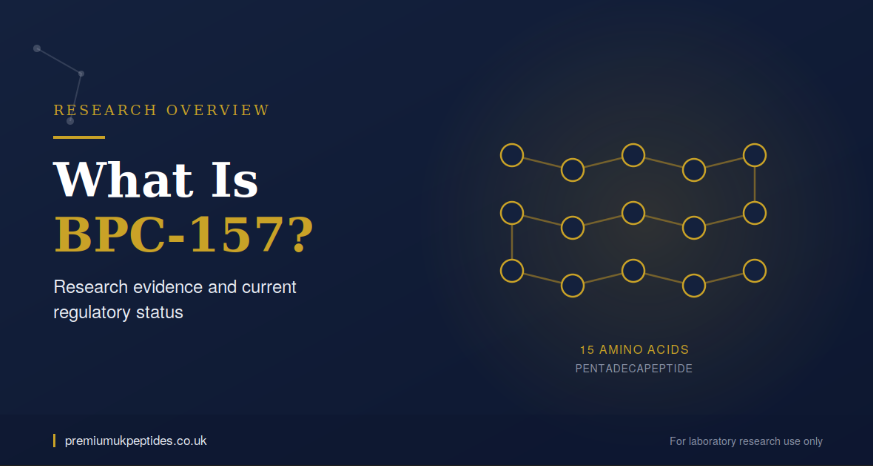
BPC-157 is a synthetic pentadecapeptide a chain of 15 amino acids modelled on a sequence found in human gastric juice. It has one of the largest preclinical research records of any peptide, and one of the thinnest human evidence bases.
That gap is the whole story of BPC-157, and it became more relevant in July 2026 when an FDA advisory committee voted to recommend the compound for pharmacy compounding, against the written objection of the agency’s own scientists.
This article covers what BPC-157 is, what the published literature actually shows, what the 2026 regulatory developments mean, and what matters when sourcing it for research.
What Is BPC-157?
BPC-157 stands for Body Protection Compound 157. It is a synthetic 15-amino-acid peptide derived from a fragment of a protective protein identified in human gastric juice.
Its technical profile:
| Classification | Synthetic pentadecapeptide |
| Amino acid sequence | Gly-Glu-Pro-Pro-Pro-Gly-Lys-Pro-Ala-Asp-Asp-Ala-Gly-Leu-Val |
| Molecular weight | ~1,419.55 daltons |
| First described | Early 1990s |
| Regulatory status | Not approved for medical use in the UK, US or EU |
It has been studied in animal and cell-culture models since the early 1990s, primarily in the context of tissue repair, gastrointestinal research and inflammatory pathways.
Our BPC-157 UK research peptide is supplied at verified purity for laboratory use.
How Does BPC-157 Work? Mechanisms in Published Research
Preclinical literature has examined several proposed mechanisms. The most frequently cited are:
Angiogenic pathways. Published animal studies have investigated BPC-157 in relation to blood vessel formation, with research examining VEGF expression and related signalling.
Nitric oxide signalling. A substantial portion of the published work much of it from Sikirić and colleagues, who have led BPC-157 research since the 1990s examines interactions with the nitric oxide system.
Growth factor expression. Animal-model research has looked at upregulation of growth factors associated with tissue repair processes.
Gut-brain axis. A separate line of research has explored BPC-157 in models relating gastrointestinal function to central nervous system signalling.
An important caveat applies to all of this: these mechanisms are described from preclinical models. How they translate to humans is not established, because the human research required to answer that has not been done. (Source: literature and patent review of BPC-157, PMC)
What the Human Evidence Actually Shows
This is where BPC-157 differs sharply from most compounds that receive similar attention.
A 2025 systematic review published in the HSS Journal screened 544 BPC-157 papers. Of the 36 that met inclusion criteria, 35 were animal studies and exactly one was clinical.
A 2026 narrative review described the compound’s human pharmacokinetic profile as critically undercharacterised — meaning basic questions about how it behaves in humans remain unanswered in the published literature.
So the position is: an extensive preclinical record spanning three decades, and a human evidence base that by any objective measure is inadequate to support clinical conclusions.
For researchers, that is not necessarily a negative — it describes an open field. But it means claims made about BPC-157 outside the research context are running well ahead of the published evidence.
Independently third-party tested. Certificate of Analysis supplied with every batch. Dispatched from the UK.
BPC-157 Regulatory Status in 2026
The regulatory picture shifted twice in 2026, and both developments are frequently misreported.
February 2026 — HHS reclassification announcement. Following a wider review of the FDA’s peptide framework, approximately 14 of 19 restricted peptides were indicated for return to Category 1 status. BPC-157 was among those named. It had been placed in Category 2 in 2023, a classification meaning a compound is not approved for human use and may not be marketed with medical claims.
July 2026 FDA advisory committee vote. On 23 July 2026, the FDA’s Pharmacy Compounding Advisory Committee (PCAC) voted 8-6, with one abstention, to recommend BPC-157 for the 503A Bulk Drug Substances List. This recommendation overruled the position of FDA staff scientists.
Two things are commonly misunderstood about that vote:
1. It is advisory, not binding. The recommendation triggers a formal rulemaking process estimated at 12–24 months. It does not make BPC-157 prescribable, compoundable or purchasable as a medicine today.
2. It applies to the United States. It has no direct effect in the UK.
In the United Kingdom, BPC-157 is not approved by the MHRA for any indication. It is supplied for laboratory research use only.
Anti-doping status. BPC-157 is explicitly named under S0 (Non-Approved Substances) on the WADA Prohibited List, meaning it is prohibited at all times both in and out of competition.
What Matters When Sourcing BPC-157 for Research
Because BPC-157 is not a regulated pharmaceutical product in any jurisdiction, quality varies considerably between suppliers. The FDA has logged adverse event reports connected to suspected contamination in unregulated material.
For laboratory work, these are the criteria worth applying:
Independent third-party testing. Testing by an external laboratory rather than in-house. Some suppliers verify their own material; independent verification is the stronger standard.
A batch-specific Certificate of Analysis. Not a generic document or a claimed figure, but a CoA corresponding to the exact batch supplied, showing the recorded purity value. See our guide on how to read a peptide Certificate of Analysis for what each section means.
HPLC verification. High-performance liquid chromatography is the standard analytical method for peptide purity assessment.
Stability and storage handling. Peptide degradation affects experimental validity. Appropriate cold-chain handling and UK-based dispatch reduce transit time and degradation risk.
Transparent research-use terms. A supplier operating properly states clearly that material is for laboratory research and not for human use.
We publish a Certificate of Analysis for every batch supplied, and our third-party tested BPC-157, dispatched from the UK is HPLC-verified. Our full Certificates of Analysis are available to view.
BPC-157 vs TB-500
These two compounds are frequently discussed together in tissue-repair research, though they are structurally unrelated.
| BPC-157 | TB-500 | |
| Type | Synthetic pentadecapeptide (15 amino acids) | Synthetic fragment of thymosin beta-4 |
| Origin | Derived from a gastric protein sequence | Derived from a naturally occurring protein |
| Primary research focus | Tissue repair, gastrointestinal models, NO signalling | Cell migration, actin regulation |
| Human clinical evidence | Minimal | Minimal |
Both are supplied for research use only, and neither is approved as a medicine.
Learn more about our TB-500 research peptide.
HPLC-verified purity, batch-specific Certificate of Analysis, same working day UK dispatch.
FAQ
What is BPC-157?
BPC-157 is a synthetic pentadecapeptide a 15-amino-acid chain — modelled on a sequence found in human gastric juice. It has been studied extensively in preclinical models since the early 1990s and is supplied for laboratory research use only.
Is BPC-157 FDA approved?
No. BPC-157 is not approved by the FDA for any therapeutic indication and has not completed FDA-regulated human clinical trials. In July 2026 an FDA advisory committee voted 8-6, with one abstention, to recommend it for the 503A Bulk Drug Substances List, but that recommendation is advisory and triggers a rulemaking process estimated at 12–24 months.
Is BPC-157 legal in the UK?
BPC-157 is not approved by the MHRA for any indication. It is supplied in the UK for laboratory and research use only, not for human or veterinary use.
How much human research exists on BPC-157?
Very little. A 2025 systematic review screened 544 papers; of the 36 meeting inclusion criteria, 35 were animal studies and one was clinical. Human pharmacokinetic data remains largely uncharacterised in published literature.
What should be checked when sourcing BPC-157 for research?
Independent third-party testing, a batch-specific Certificate of Analysis, HPLC-verified purity, appropriate cold-chain handling, and clear research-use terms.
How does BPC-157 differ from TB-500?
They are structurally unrelated. BPC-157 is a 15-amino-acid pentadecapeptide derived from a gastric protein sequence; TB-500 is a synthetic fragment of thymosin beta-4. Both are research compounds with minimal human clinical evidence.
References
- Multifunctionality and Possible Medical Application of the BPC 157 Peptide — Literature and Patent Review. PMC. ncbi.nlm.nih.gov/pmc/articles/PMC11859134
- Emerging Use of BPC-157 in Orthopaedic Sports Medicine: A Systematic Review. HSS Journal, 2025;21(4):485–495 (open access via PMC). pmc.ncbi.nlm.nih.gov/articles/PMC12313605
- July 23-24, 2026: Meeting of the Pharmacy Compounding Advisory Committee. FDA. fda.gov meeting page
- FDA Panel Backs 6 Peptides for Compounding (vote tally reporting). AJMC. ajmc.com
- WADA Prohibited List. World Anti-Doping Agency. wada-ama.org/en/prohibited-list
All products are supplied strictly for laboratory and research use only. Not for human or veterinary use. Nothing on this page is medical advice.