

GHK-Cu is a copper-bound tripeptide made from glycine, histidine and lysine, also known as Copper Tripeptide-1. Premium UK Peptides supplies GHK-Cu 50mg for UK laboratories studying fibroblasts, collagen, the extracellular matrix and skin biology.
GHK-Cu is one of the most researched copper peptides in the world, with studies going back to the 1970s. That long track record is exactly why so many labs use it as a reference peptide. Below, we explain what it is, what the research has actually found, and where the evidence stops.
For research use only. Not for human or veterinary use.
GHK-Cu 50mg at a Glance
- Full name: Glycyl-L-histidyl-L-lysine–copper(II)
- Also known as: Copper Tripeptide-1
- Quantity: 50mg
- Stated purity: 99% (per packaging)
- Storage: 2–8°C
- Main research areas: Fibroblasts, collagen, extracellular matrix, skin biology
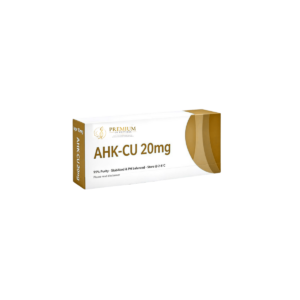
- Closest relative: AHK-Cu (alanine in place of glycine)
What Is GHK-Cu?
GHK is a small peptide — just three amino acids long. When it binds a copper ion, it becomes GHK-Cu. The name is simply its sequence in one-letter amino-acid code:
- G – Glycine
- H – Histidine
- K – Lysine
GHK occurs naturally in human plasma, and its strong affinity for copper is one of the main reasons scientists have been interested in it for decades. In ingredient and cosmetic-science literature, the copper complex is usually listed as Copper Tripeptide-1.
What Does the Research Show?
GHK-Cu has a much deeper research history than most newer peptides. Here are the key findings researchers most often refer to:
- Collagen synthesis in fibroblasts: An early study (Maquart et al., 1988, FEBS Letters) reported that GHK-Cu stimulated collagen production in cultured fibroblasts.
- Gene-expression data: A 2018 review (Pickart & Margolina, 2018, International Journal of Molecular Sciences) discussed how GHK may be associated with changes in the expression of a large number of human genes, based on genomic database analysis.
- Skin-regeneration pathways: A 2015 review (Pickart et al., 2015) summarised laboratory evidence on GHK and multiple cellular pathways relevant to skin biology.
- Skin penetration: An in-vitro study (Hostynek et al., 2010, Inflammation Research) measured how a copper tripeptide is retained in and penetrates different layers of human skin tissue.
What the research does not show: most of this work comes from cell cultures, tissue models and data analysis. Reviewers point out that laboratory findings and clinical evidence should be considered separately, and results vary depending on formulation and delivery method.
For a plain-English overview of the research, including where the evidence is strong and where it is limited, read our guide: GHK-Cu and copper peptides: what the research shows.
What Is GHK-Cu Researched For?
Fibroblast Research
Fibroblasts are the cells that build and maintain connective tissue. Cultured fibroblasts are the most common model for studying how GHK-Cu interacts with cellular processes.
Collagen Research
Collagen is the main structural protein in skin and connective tissue. GHK-Cu is widely used in laboratory assays that measure collagen synthesis.
Extracellular Matrix Research
The extracellular matrix (ECM) is the scaffold that surrounds cells. Studies have looked at GHK-Cu alongside matrix components and the enzymes that remodel them.
Skin Biology Research
Because of its links to fibroblasts, collagen and the ECM, GHK-Cu is a standard reference peptide in skin-biology labs. Browse related materials in our Skin, Hair & Beauty Research Peptides collection.
Copper-Peptide Chemistry
GHK-Cu gives researchers a well-characterised model for studying how copper binds to short peptides and how structure affects activity.
GHK-Cu vs AHK-Cu
GHK-Cu is often compared with AHK-Cu. They are closely related, but not interchangeable.
| GHK-Cu | AHK-Cu | |
|---|---|---|
| Sequence | Glycine – Histidine – Lysine | Alanine – Histidine – Lysine |
| Other name | Copper Tripeptide-1 | — |
| Research focus | Fibroblasts, collagen, ECM, skin, gene expression | Hair follicle and dermal papilla models |
| Volume of research | Extensive (since the 1970s) | Limited |
Findings for GHK-Cu should not automatically be applied to AHK-Cu, and vice versa. If you need GHK-Cu as part of a combined formulation, see GLOW 70mg (BPC-157, GHK-Cu and TB-500).
GHK-Cu 50mg Product Specifications
| Specification | Details |
|---|---|
| Product | GHK-Cu 50mg |
| Alternative Name | Copper Tripeptide-1 |
| Peptide | GHK-Cu |
| Quantity | 50mg |
| Product Type | Research peptide |
| Purity | 99% (stated on packaging) |
| Formulation | Stabilised & pH balanced (stated on packaging) |
| Storage | 2–8°C |
| Research Area | Copper-peptide & cellular research |
Purity, formulation and storage details are taken from the product packaging. Always confirm them against the batch Certificate of Analysis.
Buying GHK-Cu 50mg in the UK
When comparing suppliers, check four things: product identity, quantity, storage requirements and batch documentation.
Premium UK Peptides supplies GHK-Cu 50mg as part of its UK research peptide range, with Certificates of Analysis available and delivery details on our shipping page.
GHK-Cu 50mg FAQs
What is GHK-Cu 50mg?
GHK-Cu 50mg is a copper-bound tripeptide (glycine–histidine–lysine), also called Copper Tripeptide-1, supplied in a 50mg quantity for laboratory and scientific research.
What does GHK-Cu stand for?
GHK is the one-letter code for Glycine (G), Histidine (H) and Lysine (K). Cu is the chemical symbol for copper, which binds to the peptide to form the GHK-Cu complex.
Is GHK-Cu the same as Copper Tripeptide-1?
Yes. Copper Tripeptide-1 is another name for GHK-Cu, commonly used in cosmetic-science and ingredient literature.
What is GHK-Cu researched for?
GHK-Cu has been studied in fibroblast biology, collagen synthesis, extracellular matrix processes, skin biology, gene-expression research and copper-peptide chemistry.
Why is GHK-Cu studied in skin research?
Much of its research history involves fibroblasts, collagen and the extracellular matrix — the building blocks of skin and connective tissue — which makes it a common reference peptide in skin-biology laboratories.
Is GHK-Cu the same as AHK-Cu?
No. GHK-Cu contains glycine–histidine–lysine, while AHK-Cu contains alanine–histidine–lysine. They are related copper tripeptides but different research materials.
How should GHK-Cu 50mg be stored?
The product packaging specifies storage at 2–8°C. Researchers should follow the product label and their laboratory’s storage procedures.
What purity is GHK-Cu 50mg?
The packaging states 99% purity. This should be checked against the Certificate of Analysis for the specific batch.
Where can I buy GHK-Cu 50mg in the UK?
Premium UK Peptides supplies GHK-Cu 50mg as part of its UK research peptide range, subject to availability.
Is GHK-Cu 50mg intended for human use?
No. It is supplied strictly for laboratory and scientific research and is not intended for human or veterinary use.
References
- Maquart FX, et al. Stimulation of collagen synthesis in fibroblast cultures by the tripeptide-copper complex glycyl-L-histidyl-L-lysine-Cu2+. FEBS Letters. 1988. PubMed
- Pickart L, Margolina A. Regenerative and Protective Actions of the GHK-Cu Peptide in the Light of the New Gene Data. International Journal of Molecular Sciences. 2018;19(7):1987. PMC
- Pickart L, Vasquez-Soltero JM, Margolina A. GHK Peptide as a Natural Modulator of Multiple Cellular Pathways in Skin Regeneration. BioMed Research International. 2015. PMC
- Hostynek JJ, et al. Human skin retention and penetration of a copper tripeptide in vitro as function of skin layer towards anti-inflammatory therapy. Inflammation Research. 2010. Springer
Research-Only Notice
GHK-Cu 50mg is supplied strictly for laboratory and scientific research. It is not intended for human or veterinary use, or for the diagnosis, treatment, prevention or management of any disease or medical condition.
Research summarised on this page is provided for scientific context only. Findings from laboratory, cellular or ex-vivo studies should not be read as evidence of established human benefit, safety or efficacy. For UK regulatory information, see the MHRA.
Reviews
There are no reviews yet.