
All products are supplied strictly for laboratory and research use only. Not for human or veterinary use.
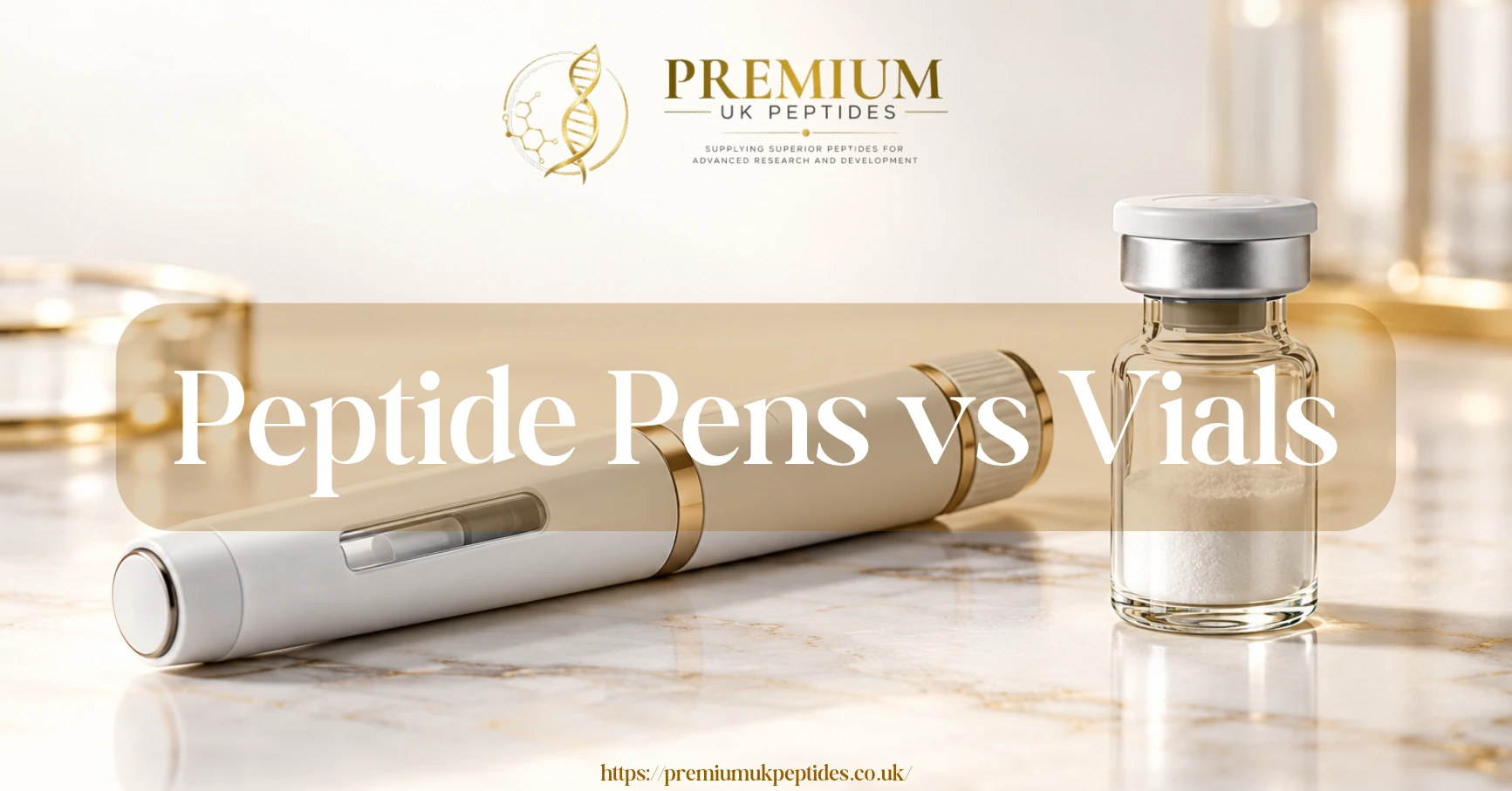
Research peptides are supplied in two main formats: as a lyophilised powder, or as a pre-mixed liquid in a pen.
Most of the UK market supplies lyophilised powder, and most of the published guidance on peptide handling — including our own guide to storing lyophilised peptides — is written with powder in mind. That leaves a gap: if you are working with a pre-mixed format, a lot of the standard advice does not apply directly — and some of it, applied literally, would damage the material.
This article covers what each format is, what the formulation science says about stability in each, and what the practical differences mean for storage and handling.
The Two Formats
Lyophilised powder. The peptide is freeze-dried — water is removed under vacuum at low temperature, leaving a dry cake, usually in a sealed vial. This is the default across most of the research peptide market.
Pre-mixed liquid pen. The peptide is supplied already in solution, in a sealed pen device. The solution is formulated — buffered, pH-adjusted, and often containing stabilising excipients — rather than simply dissolved.
That second distinction matters more than it might appear, and it is the source of most of the confusion around the format.
Our own range includes both. IGF-1 LR3, for example, is supplied as lyophilised powder, while Wolverine 20mg and HGH 100IU are supplied in pen format. The format is stated on each product page, so check it before applying any storage guidance.
Why Lyophilised Is the Industry Default
Several of the main peptide degradation pathways depend on water being present.
Hydrolysis requires it. Deamidation — the conversion of asparagine and glutamine residues, and one of the most common degradation routes — proceeds through a water-dependent mechanism. Aggregation is driven by interactions that occur in solution.
Others, oxidation in particular, are not primarily water-driven; they depend more on oxygen exposure, light and trace metal contamination. But removing water slows a substantial share of the degradation routes, which is why a properly lyophilised peptide in a sealed vial, stored cold, generally remains stable far longer than the same peptide sitting in solution.
The standard manufacturer guidance reflects this. GenScript describes the shelf life of peptides in solution as very limited compared with lyophilised material, and recommends against storing peptides in solution at all where it can be avoided.
That guidance is sound — and it is written about a specific situation: a researcher reconstituting powder in bacteriostatic water and keeping the leftover. It is not the same situation as a commercially formulated solution.
What a Formulated Solution Actually Is
This is the part that gets flattened in most discussions of the topic. “In solution” covers two very different things.
A peptide dissolved in bacteriostatic water sits in whatever conditions that water happens to provide. A formulated solution is engineered against the specific degradation pathways that affect peptides in water.
A 2023 review in Pharmaceutics sets out the strategies used (Nugrahadi et al.):
pH control. Degradation rates in solution are strongly pH-dependent, and the optimum differs by pathway. In the formulation studies reviewed, a pH range of around 3–5 reduced deamidation, and conditions below pH 5 reduced oxidation of cysteine, tyrosine and histidine residues. The optimum for any given peptide depends on its sequence and the rest of the formulation — oxytocin, for instance, was found most stable at pH 4.5 specifically. pH is generally the largest single lever available in a liquid formulation, but there is no universal correct value.
Buffer selection. Buffer identity affects stability independently of pH. The same peptide at the same pH degraded at different rates in citrate, phosphate, glutamate and aspartate buffers — phosphate accelerated hydrolysis in one case, while acetate was better for another peptide at the same pH.
Co-solvents. Glycerol, propylene glycol and ethanol slow deamidation, likely by reducing the dielectric constant and effective water content of the formulation.
Polyols. Sucrose and mannitol reduce aggregation and oxidation. Mannitol specifically protects methionine-containing peptides from metal-catalysed oxidation.
Air exclusion. Purging with inert gas limits oxidation, which matters for sequences containing methionine, cysteine, histidine or tryptophan.
Terms like “stabilised” and “pH balanced” on a product label describe formulation characteristics in this general category. What they do not tell you is which specific buffers, excipients or pH targets a given manufacturer has used, or what stability data sits behind the formulation. That detail is product-specific, and worth asking about rather than assuming.
What This Means in Practice
Neither format is simply better. They sit at different points on the same trade-off.
| Lyophilised vial | Pre-mixed pen | |
|---|---|---|
| State | Dry powder | Formulated solution |
| Shelf stability | Longer, when stored correctly | Shorter — degradation pathways are active |
| Preparation required | Yes | No |
| Source of variability | Reconstitution — solvent choice, volume accuracy, technique | Formulation is fixed at manufacture |
| Storage sensitivity | Tolerates a wider range | Narrower, and the limits are firmer |
| Freezing | Appropriate for long-term storage | Not appropriate — see below |
The practical difference is where the variability lives. With powder, consistency depends on how it is reconstituted: which solvent, how accurately the volume is measured, how it is handled. A pre-mixed format removes that step, and with it the variation associated with solvent selection and preparation technique.
It does not remove variation altogether. Batch-to-batch consistency still depends on the formulation and manufacturing process, and stability still depends on storage conditions. What changes is that one source of variation moves from the researcher’s bench to the manufacturer’s process.
Pen-format products are supplied pre-mixed, with a batch Certificate of Analysis and same working day UK dispatch.
Storage: Where the Formats Diverge Most
This is the point where applying powder guidance to a pen does real damage.
Lyophilised powder is generally stored frozen for the long term. Manufacturer guidance commonly specifies −20°C, and colder for sensitive sequences.
Do not freeze a pen unless its own documentation explicitly says to. Freezing a formulated solution can cause aggregation or precipitation, and freeze–thaw cycles are a recognised stress on peptides in solution — GenScript advises avoiding them for peptides in solution generally. Whether a specific formulation tolerates freezing depends on that formulation and its validation, so the product’s own instructions are what govern. Damage from freezing is not always visible.
Pens are normally refrigerated. Our Wolverine research pen, for example, specifies 2–8°C.
Storage temperature is not uniform across compounds. Different peptides have different stability profiles depending on their sequence — which residues they contain, how prone those are to oxidation or deamidation. A compound rich in methionine or cysteine has different requirements from one that contains neither.
This means the temperature on the label is specific to that product. It should not be assumed to carry across to a different compound, even one supplied in the same format by the same supplier. Always work from the individual product’s label and documentation.
Handling on Arrival
Common to both formats:
- Move to specified storage promptly. Short periods in transit are accounted for in supply; prolonged ambient storage is not.
- Protect from light. Tryptophan, tyrosine and phenylalanine residues, and disulfide bonds, are all susceptible to photodegradation.
- Keep sealed. Oxidation is driven in part by dissolved oxygen and air exposure.
- Check documentation against the product. Batch number on the Certificate of Analysis should match the item supplied.
Specific to pens:
- Do not freeze. Covered above, and worth repeating because it is the most common and most damaging error.
- Avoid agitation. Mechanical stress contributes to aggregation in solution.
- Observe the label temperature for that specific product, not a general figure.
Our peptide storage guide covers degradation pathways and residue sensitivity in more detail.
What to Check When Comparing Suppliers
Format aside, the documentation question is the same either way:
- Batch-specific Certificate of Analysis, not a generic specification sheet
- Independent third-party testing rather than in-house verification
- Stated storage conditions for that product, not a blanket figure applied across a range
- Clear research-use terms — our guide to buying research peptides legally in the UK explains why these matter
If you are new to reading certificates, our guide on how to read a peptide Certificate of Analysis explains what each section covers — including the difference between HPLC purity and net peptide content, which are frequently confused.
Purity itself answers only part of the quality question — HPLC doesn’t detect endotoxins, heavy metals or residual solvents. What large-scale testing found on that front is covered in Peptide Purity and Contamination: What the Data Shows.
Our Certificates of Analysis are published for the range.
Third-party tested with a batch-specific Certificate of Analysis you can read before you order.
Frequently Asked Questions
What is the difference between a peptide pen and a vial?
A vial typically contains lyophilised (freeze-dried) powder. A pen contains the peptide already in solution — formulated with buffers, pH adjustment and stabilising excipients rather than simply dissolved. The two are stored differently.
Are pre-mixed peptide pens less stable than lyophilised powder?
Peptides in solution have shorter shelf lives than lyophilised material, because water enables the main degradation pathways. A formulated solution is engineered to slow those pathways through pH control, buffer selection and stabilising excipients, but it does not eliminate them.
Can peptide pens be frozen?
Follow the storage instructions supplied with the specific product, and do not freeze a pen unless its documentation explicitly permits it. Freezing a formulated solution can cause aggregation or precipitation, and freeze–thaw cycles are a recognised stress on peptides in solution. Pens are normally refrigerated rather than frozen, and damage from freezing is not always visible.
Why do different peptides need different storage temperatures?
Stability depends on amino acid sequence. Peptides containing methionine, cysteine or tryptophan are more prone to oxidation; those containing asparagine or glutamine are more prone to deamidation. These differences mean storage requirements are compound-specific rather than uniform.
What does “stabilised and pH balanced” mean on a peptide pen?
It describes formulation characteristics aimed at slowing degradation in solution — the general category includes pH control, buffer selection, co-solvents and polyol stabilisers. The label alone does not specify which of these a particular manufacturer has used, or what stability data supports the formulation; that is product-specific.
Does a pen remove the need for reconstitution?
Yes. The material is supplied already in solution, which removes solvent choice, volume accuracy and preparation technique as sources of variation between experiments. Other sources of variation — formulation, manufacturing and storage conditions — still apply.
References
- Nugrahadi, P.P.; Hinrichs, W.L.J.; Frijlink, H.W.; Schöneich, C.; Avanti, C. Designing Formulation Strategies for Enhanced Stability of Therapeutic Peptides in Aqueous Solutions: A Review. Pharmaceutics 2023, 15(3), 935. https://doi.org/10.3390/pharmaceutics15030935
- GenScript. Peptide Storage and Handling Guidelines.
All products are supplied strictly for laboratory and research use only. Not for human or veterinary use.