
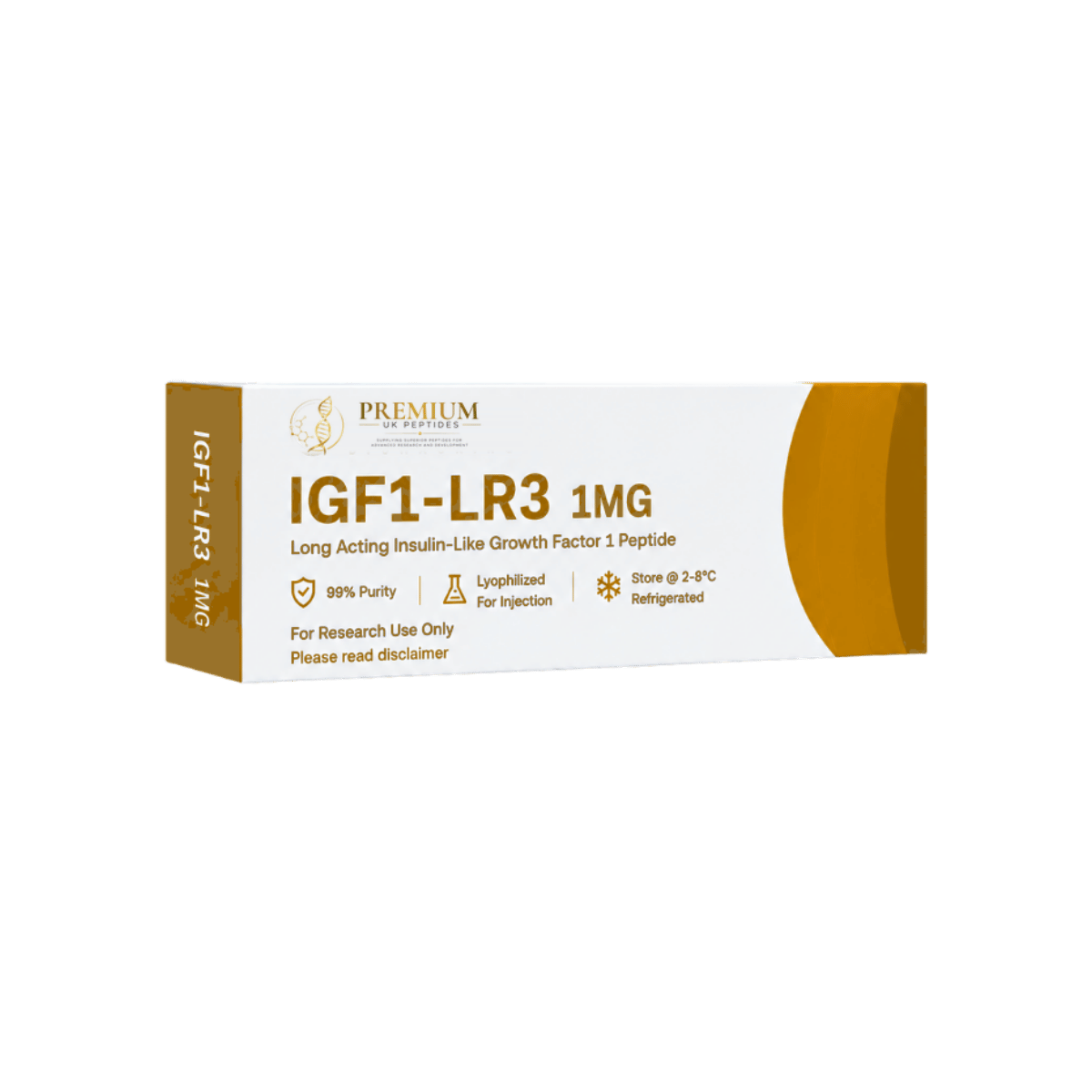
IGF-1 LR3 is a laboratory-modified version of insulin-like growth factor 1, engineered to resist the binding proteins that normally regulate IGF-1 in circulation. Premium UK Peptides supplies IGF-1 LR3 1mg for UK laboratories studying growth factor pathways, receptor binding and cell signalling models.
What makes IGF-1 LR3 distinct is not the receptor it acts on — that is the same IGF-1 receptor native IGF-1 uses — but how long it stays available to act on it. This page sets out what the modification actually does and what the research covers.
For research use only. Not for human or veterinary use. Last updated: October 2026.
Key Takeaways
- IGF-1 LR3 is an 83-amino-acid analogue of native IGF-1, which has 70 amino acids.
- Two modifications distinguish it: an arginine substitution at position 3, and a 13-amino-acid extension at the N-terminus.
- It binds IGF-binding proteins with much lower affinity than native IGF-1, which is the basis of its extended stability in research models.
- It is not an approved medicine in the UK or elsewhere, and is prohibited in sport under WADA rules.
- Supplied lyophilised at 99% purity, refrigerated at 2–8°C.
IGF-1 LR3 1mg at a Glance
| Specification | Details |
|---|---|
| Product | IGF-1 LR3 |
| Alternative names | Long R3-IGF-1, Long Arginine 3-IGF-1, IGF-1 Long R3 |
| Peptide type | Recombinant protein analogue, 83 amino acids |
| Molecular formula | C400H625N111O115S9 |
| Molecular weight | 9,117.60 g/mol |
| Native IGF-1 comparison | 70 amino acids, ~7,649 g/mol |
| Strength | 1mg |
| Form | Lyophilised powder |
| Purity | 99% |
| Storage | 2–8°C, refrigerated |
| Category | Performance & Muscle Growth |
Specifications are taken from the product packaging. Always check them against the batch Certificate of Analysis.
Purity and Batch Documentation
Every batch is independently third-party tested before dispatch, with purity measured by HPLC — the standard analytical method for peptide and protein purity.
If you are new to reading these documents, our guide on how to read a peptide Certificate of Analysis explains what each section means, including why net peptide content and HPLC purity are different figures that are frequently confused.
You can view certificates for our range on the Certificates of Analysis page.
What Is IGF-1 LR3?
IGF-1 LR3 stands for Long Arginine 3-IGF-1. It is a recombinant analogue of insulin-like growth factor 1, a protein involved in cell growth and proliferation signalling.
The name describes the two modifications made to the native sequence:
- “Long” refers to a 13-amino-acid extension (MFPAMPLLSLFVN) added to the N-terminus
- “R3” refers to arginine replacing glutamic acid at the third position
Together these take the molecule from 70 amino acids to 83, and change how it behaves in a laboratory system — without changing what it binds to.
How IGF-1 LR3 Differs From Native IGF-1
This is the part that matters for research design, and it is frequently misunderstood.
Native IGF-1 circulates bound to a family of proteins called IGF-binding proteins (IGFBPs). These regulate how much free IGF-1 is available to interact with its receptor at any point. In practical terms, they act as a buffer.
The LR3 modifications substantially reduce affinity for those binding proteins. Less sequestration by IGFBPs means more of the molecule remains unbound and available to interact with the IGF-1 receptor.
| Native IGF-1 | IGF-1 LR3 | |
|---|---|---|
| Amino acids | 70 | 83 |
| Molecular weight | ~7,649 g/mol | 9,117.60 g/mol |
| IGFBP affinity | Normal | Substantially reduced |
| Receptor target | IGF-1 receptor | IGF-1 receptor (unchanged) |
| Relative potency | Reference | Reported as approximately 3× in published comparisons |
On half-life: published figures vary considerably between sources, with reported ranges from roughly 20–30 hours up to 56–72 hours. Those figures are not directly comparable — they depend on the model, the assay and the conditions measured. Anyone designing around a specific stability window should work from the primary literature relevant to their own system rather than a single quoted number.
What Is IGF-1 LR3 Studied For?
Growth Factor Signalling
IGF-1 LR3 is used in research examining how growth factor signals are transmitted through the IGF-1 receptor and the downstream pathways that follow, including PI3K/Akt and MAPK signalling cascades.
Cell Culture Applications
The reduced IGFBP affinity is the reason IGF-1 LR3 appears frequently in cell culture research. In serum-containing media, binding proteins can interfere with experimental consistency; an analogue less affected by them gives more predictable availability across a culture.
Receptor Binding Studies
Because the modification changes binding protein interaction without changing the receptor target, IGF-1 LR3 is used in comparative work examining how binding protein interaction affects receptor-level activity.
Proliferation and Differentiation Models
Published research has examined IGF-1 and its analogues in models of cell proliferation and differentiation across several tissue types. These are laboratory models, and findings are not transferable to humans.
Storage and Handling
IGF-1 LR3 is supplied lyophilised (freeze-dried), which is the more stable of the two states a peptide or protein exists in. Water is what allows most degradation reactions to proceed, so removing it slows them considerably.
The packaging specifies refrigerated storage at 2–8°C. Keep vials sealed and protected from light, and allow a cold vial to reach room temperature before opening — opening a cold vial draws in ambient air, and moisture condenses onto the cold powder.
Our peptide storage guide covers handling on arrival, degradation pathways and which residues are most vulnerable.
Regulatory and Anti-Doping Status
United Kingdom: IGF-1 LR3 is not authorised by the MHRA as a medicine for any indication. It is supplied for laboratory research use only.
Anti-doping: IGF-1 and its analogues appear on the World Anti-Doping Agency’s Prohibited List in the category covering peptide hormones, growth factors and related substances — prohibited at all times, both in and out of competition. Anyone competing under anti-doping rules should check the current WADA Prohibited List directly.
Related Research Compounds
Researchers working on growth factor pathways frequently also work with growth hormone secretagogues, which act through a different mechanism:
- CJC-1295 (No DAC) — a growth hormone-releasing hormone analogue
- Ipamorelin — a growth hormone secretagogue
- CJC-1295 + Ipamorelin — supplied as a combination
- HGH 100IU
The distinction matters: secretagogues act upstream on growth hormone release, while IGF-1 LR3 acts directly at the IGF-1 receptor.
Buying IGF-1 LR3 1mg in the UK
Whether you are searching for IGF-1 LR3 UK, buy IGF-1 LR3 or Long R3 IGF-1, these are the criteria worth comparing between suppliers:
- Batch-specific purity documentation, not a generic product specification
- Independent third-party testing rather than in-house verification
- Clear storage requirements and appropriate cold-chain handling
- Transparent research-use terms
Premium UK Peptides is a UK-based supplier. We publish a Certificate of Analysis for our range, dispatch from the UK with tracked delivery, and operate a clear returns policy.
IGF-1 LR3 FAQs
What is IGF-1 LR3?
IGF-1 LR3 (Long Arginine 3-IGF-1) is a recombinant 83-amino-acid analogue of insulin-like growth factor 1. It differs from native IGF-1 by an arginine substitution at position 3 and a 13-amino-acid N-terminal extension.
What does LR3 stand for?
“Long” refers to the 13-amino-acid extension added to the N-terminus. “R3” refers to the arginine substitution at the third position of the sequence.
How is IGF-1 LR3 different from IGF-1?
It binds IGF-binding proteins with substantially lower affinity, which means more of the molecule stays available to interact with the IGF-1 receptor. The receptor it acts on is the same; what changes is availability.
What is the molecular weight of IGF-1 LR3?
9,117.60 g/mol, with the formula C400H625N111O115S9. Native IGF-1 is approximately 7,649 g/mol.
How long does IGF-1 LR3 remain stable?
Published figures vary widely between sources and measurement conditions, with reported ranges from roughly 20–30 hours up to 56–72 hours. These are not directly comparable. Researchers should work from primary literature relevant to their own model.
What is IGF-1 LR3 researched for?
Growth factor signalling, cell culture applications, receptor binding studies, and proliferation and differentiation models. Published evidence is preclinical.
Is IGF-1 LR3 approved as a medicine in the UK?
No. It is not authorised by the MHRA for any indication and is supplied strictly for laboratory research.
Is IGF-1 LR3 banned in sport?
Yes. IGF-1 and its analogues appear on the WADA Prohibited List under peptide hormones and growth factors, prohibited at all times.
How pure is your IGF-1 LR3?
99%, verified by HPLC. Certificates of Analysis are available on our CoAs page.
How should IGF-1 LR3 be stored?
The packaging specifies refrigerated storage at 2–8°C. Keep vials sealed and protected from light. Our storage guide covers handling on arrival.
Is IGF-1 LR3 intended for human use?
No. This product is supplied strictly for laboratory and scientific research and is not intended for human or veterinary use.
References
- IGF-1 LR3 — molecular profile and structural modifications. Wikipedia
- WADA Prohibited List. World Anti-Doping Agency. wada-ama.org
Research-Only Notice
IGF-1 LR3 1mg is supplied strictly for laboratory and scientific research. It is not intended for human or veterinary use, or for the diagnosis, treatment or prevention of any medical condition.
The research discussed on this page is laboratory and preclinical. It should not be read as evidence of established human benefit, safety or efficacy. IGF-1 LR3 is not an MHRA-licensed medicine — see the MHRA for UK regulatory information.
Reviews
There are no reviews yet.