

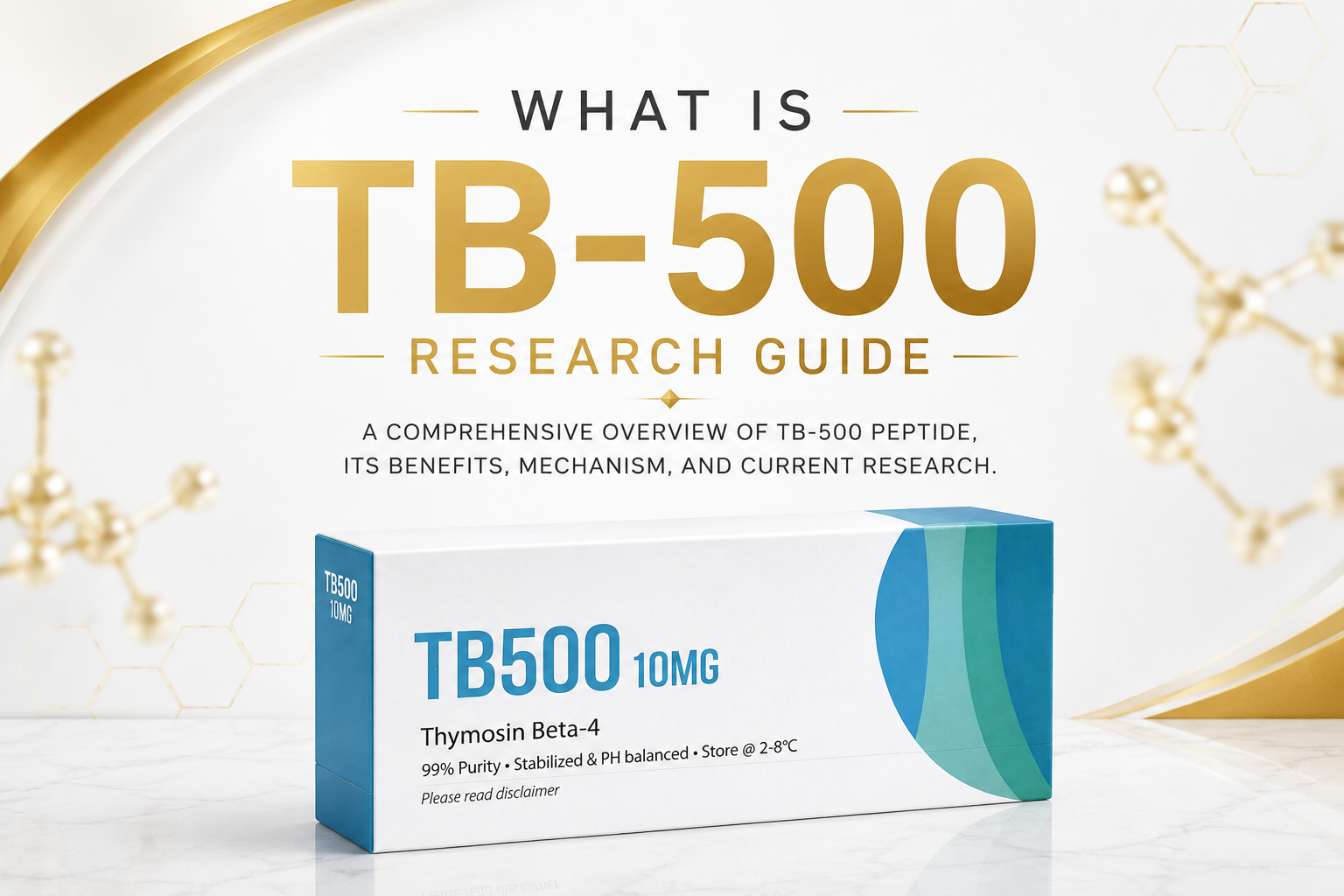
By the Premium UK Peptides Research Team · Updated August 2026 · 8 min read
What Is TB-500?
TB-500 is the name commonly used for a synthetic fragment of Thymosin Beta-4 (Tβ4) — a small protein naturally present throughout the body that plays a central role in how cells move, organise, and respond to injury. Because cellular migration is one of the first steps in any repair process, TB-500 has become a recurring name in regenerative and musculoskeletal research, frequently discussed alongside BPC-157 as one of the two most-referenced recovery peptides.
Here’s what TB-500 actually is, how it’s believed to work, and what the underlying research base looks like.
Key Takeaways
- TB-500 is a short synthetic fragment based on Thymosin Beta-4, a naturally occurring actin-regulating protein.
- Its proposed mechanism centres on actin sequestration, which governs how cells move and reorganise.
- Research links Thymosin Beta-4 to wound healing, angiogenesis, and anti-inflammatory activity.
- Most of the strongest published evidence concerns the full-length Tβ4 protein, not the shorter TB-500 fragment specifically.
- It is not approved for human or veterinary use and is sold strictly for laboratory research.
What Is TB-500, Exactly?
Thymosin Beta-4 is a 43-amino-acid protein found in almost every cell type in the body except red blood cells. It’s one of the most abundant intracellular peptides in mammalian tissue, which is part of why it has attracted so much research attention. TB-500 refers specifically to a much shorter synthetic fragment of that protein — commonly cited as the seven-amino-acid active region — designed to reproduce some of the parent molecule’s biological activity in a smaller, more stable form.
How TB-500 Is Thought to Work
The core mechanism researchers focus on is actin sequestration. Actin is the structural protein that forms a cell’s internal scaffolding and drives its ability to move. Thymosin Beta-4 binds to actin monomers and holds them in reserve, ready to be rapidly assembled into filaments whenever a cell needs to migrate — for example, toward the site of an injury. A review published on PMC/NIH describes how Thymosin Beta-4 promotes cell migration and wound healing while also exhibiting anti-inflammatory properties and suppressing markers of programmed cell death, across tissue types ranging from skin to the cornea.
What Researchers Study TB-500 For
| Research Area | What’s Being Investigated |
|---|---|
| Cell migration | Actin dynamics and how cells relocate to damaged tissue |
| Wound healing | Closure rates and inflammatory marker changes |
| Angiogenesis | New blood vessel formation supporting tissue repair |
| Musculoskeletal biology | Muscle, tendon and ligament recovery mechanisms |
| Extracellular matrix | Collagen alignment and structural tissue remodelling |
TB-500 vs. Full-Length Thymosin Beta-4: An Important Distinction
It’s worth being precise here, because the research literature often isn’t. Most of the strongest published data — including clinical work on corneal healing, cardiac repair, and hair follicle biology — relates to the complete 43-amino-acid Thymosin Beta-4 protein, not the shorter TB-500 fragment sold commercially. TB-500 is designed to reproduce some of that activity, but the fragment and the full protein aren’t automatically interchangeable in research terms, and this distinction matters when interpreting any claims about TB-500 specifically.
Compounds Often Studied Alongside TB-500
In recovery-focused research, TB-500 is rarely examined in isolation. It’s frequently paired with BPC-157, which targets a complementary set of tissue-repair pathways and is covered in full in our dedicated BPC-157 overview, and GHK-Cu, studied for its role in collagen and extracellular matrix remodelling. Combined formulations such as Wolverine and Recovery Blend are also designed with TB-500-adjacent mechanisms in mind.
TB-500 in Our Research Range
For laboratory and in-vitro research applications, Premium UK Peptides supplies TB-500 20mg as a high-purity, third-party tested research peptide within our Recovery & Healing collection. It’s commonly studied alongside:
- BPC-157 — studied for tissue repair and angiogenesis
- GHK-Cu — studied for collagen and extracellular matrix research
- Wolverine — a multi-pathway recovery research formula
- Recovery Blend — a combined multi-peptide recovery matrix
Every batch is independently lab tested — purity data is available on our Certificates of Analysis page before ordering from our full research peptide range.
Frequently Asked Questions
What is TB-500? TB-500 is the name commonly used for a synthetic fragment of Thymosin Beta-4, a naturally occurring protein involved in cell migration, actin regulation and tissue repair. What is TB-500 studied for? Researchers study TB-500 in relation to cell migration, wound healing, angiogenesis, and the biology of tendons, ligaments and muscle tissue. Is TB-500 the same as Thymosin Beta-4? No. TB-500 refers to a short synthetic fragment (commonly cited as amino acids 17-23) of the full 43-amino-acid Thymosin Beta-4 protein. Most of the strongest published evidence relates to the full-length protein rather than the fragment alone. Is TB-500 approved for human use? No. TB-500 is not approved as a medicine, supplement, or food product. It is supplied strictly for laboratory and in-vitro research use and is not intended for human or animal consumption. What compounds are often studied alongside TB-500? TB-500 is frequently studied alongside BPC-157, GHK-Cu, and growth-hormone secretagogues such as CJC-1295 with Ipamorelin, as part of broader tissue-repair research protocols.
The Bottom Line
TB-500’s research relevance comes down to a well-established biological mechanism — actin sequestration — that sits upstream of almost every form of tissue repair. A 2026 scoping review in Applied Sciences notes that while thymosin beta-4/TB-500 are widely discussed in tissue-healing and musculoskeletal research, the scope of the supporting literature — and how much applies to the fragment specifically versus the full protein — still needs careful interpretation. Browse our Recovery & Healing category to see the compounds most frequently studied alongside it, or read our BPC-157 overview for the most-studied companion compound.
Disclaimer: This article is intended for educational and informational purposes only. TB-500 and the compounds referenced are sold by Premium UK Peptides strictly for laboratory and in-vitro research use, are not for human or animal consumption, and are not intended to diagnose, treat, cure, or prevent any disease. Nothing in this article should be interpreted as medical advice — always consult a qualified healthcare professional for anything related to your personal health.