
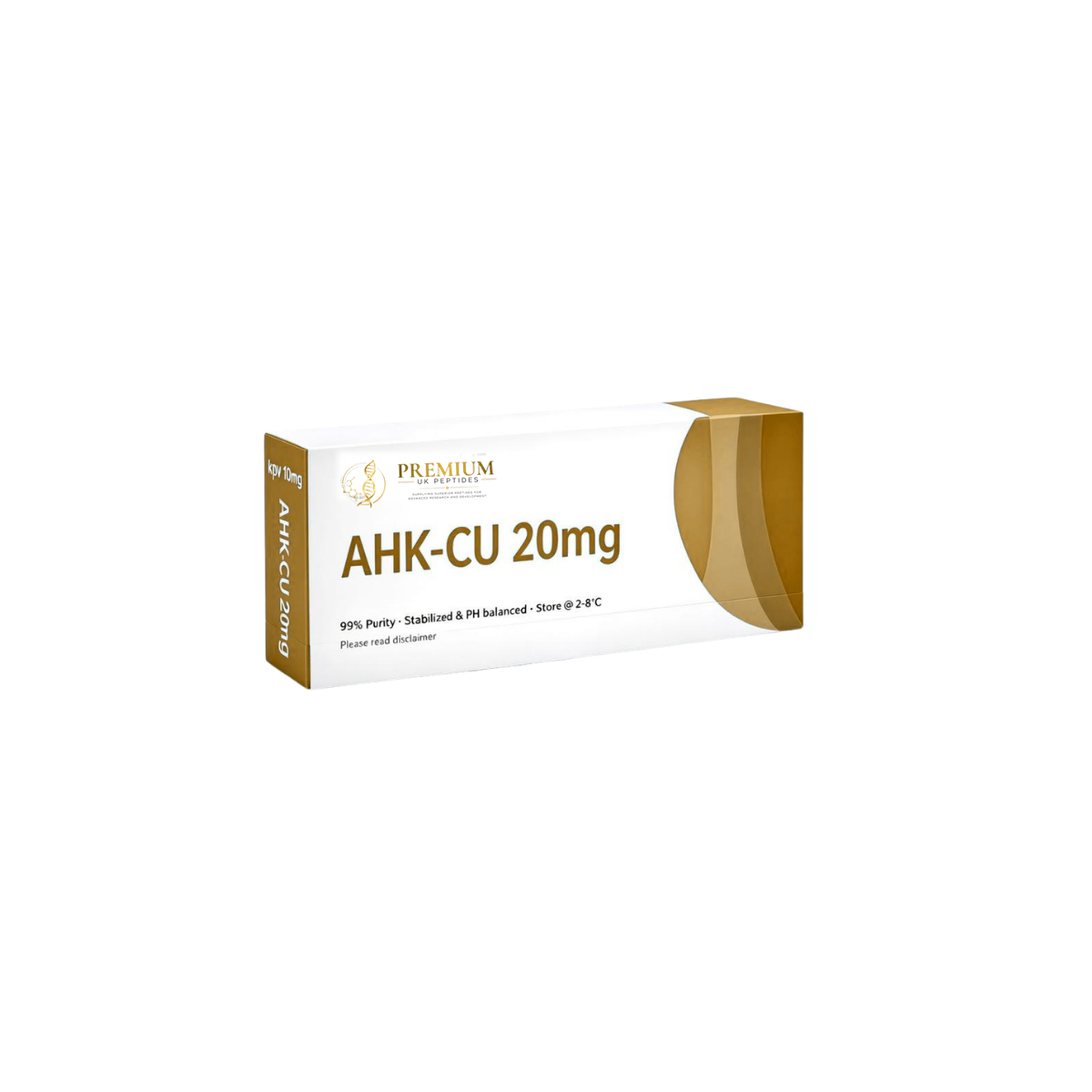
AHK-Cu is a copper-bound tripeptide made from three amino acids — alanine, histidine and lysine. Premium UK Peptides supplies AHK-Cu 20mg for UK laboratories and researchers working on hair follicle biology, dermal papilla cells and copper-peptide chemistry.
If you have come across AHK-Cu while reading about GHK-Cu, you are not alone. The two are often mentioned together, but they are different molecules — and that difference matters for anyone designing an experiment. This page covers what AHK-Cu is, what the published research actually shows, and where its limits are.
For research use only. Not for human or veterinary use.
AHK-Cu at a Glance
- Full name: L-alanyl-L-histidyl-L-lysine–copper(II) (AHK-Cu)
- Type: Copper-bound tripeptide
- Quantity: 20mg
- Main research area: Hair follicle and dermal papilla cell models
- Key study: Pyo et al., 2007 — ex-vivo human hair follicles and in-vitro dermal papilla cells
- Closest relative: GHK-Cu (glycine in place of alanine)
- Status: Research material — no human clinical trials
What Is AHK-Cu 20mg?
AHK-Cu is a short peptide chain of three amino acids with a copper ion bound to it. Its name is simply its sequence written in one-letter amino-acid code:
- A – Alanine
- H – Histidine
- K – Lysine
The “Cu” is the chemical symbol for copper. Histidine is the amino acid mainly responsible for holding the copper in place, which is why copper tripeptides of this type are studied as a group.
AHK-Cu belongs to the same family as GHK-Cu. The two share histidine and lysine, but differ in the first position — and in peptide science, a single swapped amino acid can change how a molecule behaves.
What Does the Research Show?
The most cited paper on AHK-Cu is a 2007 study by Pyo and colleagues, published in Archives of Pharmacal Research (Pyo et al., 2007 – Archives of Pharmacal Research).
The researchers worked with two laboratory models:
- Ex-vivo: human hair follicles isolated and kept alive in culture, outside the body
- In-vitro: cultured human dermal papilla cells — the specialised cells at the base of the follicle that help regulate hair growth
Under their experimental conditions, they reported that AHK-Cu was associated with:
- Increased elongation of the isolated hair follicles
- Increased proliferation of dermal papilla cells
- Changes in markers linked to programmed cell death (apoptosis) in those cells
What this study does not show: it was not carried out in people. Results from isolated follicles and cell cultures are an early step in research, and they are not evidence that AHK-Cu is a proven or safe hair treatment. The study also dates from 2007, and the body of independent follow-up research remains small.
AHK-Cu 20mg Research Applications
Based on the published literature, AHK-Cu is most relevant to laboratories working in the following areas.
Hair Follicle Biology
Studying follicle growth phases and elongation in isolated follicle models under controlled conditions.
Dermal Papilla Cell Research
Looking at how cultured dermal papilla cells respond to different concentrations of a copper peptide, including proliferation and cell-survival markers.
Copper-Peptide Chemistry
Investigating how copper binds to short peptides, and how structure affects stability and activity.
Structure–Activity Comparisons
Comparing AHK-Cu with GHK-Cu to see how a single amino-acid change influences results in the same experimental setup.
AHK-Cu vs GHK-Cu: What’s the Difference?
This is one of the most common questions we get. The short answer: they are cousins, not twins.
| AHK-Cu | GHK-Cu | |
|---|---|---|
| Sequence | Alanine – Histidine – Lysine | Glycine – Histidine – Lysine |
| Copper-bound | Yes | Yes |
| Research focus | Hair follicle and dermal papilla models | Broader skin, tissue and gene-expression research |
| Volume of published research | Limited | Considerably larger |
Because the sequences differ, findings for GHK-Cu should not be assumed to apply to AHK-Cu, and the reverse is also true. If your work involves both, see our GHK-Cu research peptide, or the multi-peptide GLOW 70mg formulation that includes GHK-Cu.
AHK-Cu 20mg Product Specifications
| Specification | Details |
|---|---|
| Product | AHK-Cu 20mg |
| Peptide | AHK-Cu |
| Full Name | L-Alanyl-L-Histidyl-L-Lysine-Cu²⁺ |
| Quantity | 20mg |
| Product Type | Research peptide |
| Research Area | Copper-peptide research |
| Key Research Area | Hair follicle & cellular research |
| Category | Skin, Hair & Beauty Research Peptides |
| Supplied In | United Kingdom |
Buying AHK-Cu 20mg in the UK
When comparing research peptide suppliers, the details that matter are clear product identity, honest research information and batch documentation you can check.
Premium UK Peptides lists AHK-Cu 20mg as part of its UK research peptide range. Before ordering, we recommend reviewing the relevant Certificate of Analysis and confirming the material suits your laboratory’s requirements. Delivery details are on our shipping page.
Researchers working on hair follicle models may also want to look at KLOW 80mg and other materials in our Skin, Hair & Beauty collection.
AHK-Cu 20mg FAQs
What is AHK-Cu 20mg?
AHK-Cu 20mg is a copper-bound tripeptide (alanine–histidine–lysine) supplied in a 20mg quantity for laboratory and scientific research.
What does AHK-Cu stand for?
AHK is the one-letter code for its three amino acids: Alanine (A), Histidine (H) and Lysine (K). Cu is the chemical symbol for copper, which binds to the peptide.
What is AHK-Cu researched for?
Most published interest centres on hair follicle biology and dermal papilla cells, along with broader copper-peptide and cellular research.
Has AHK-Cu been studied on human hair follicles?
Yes, but only in the lab. A 2007 study (Pyo et al., Archives of Pharmacal Research) used isolated human hair follicles kept outside the body and cultured dermal papilla cells. It was not a human clinical trial.
Is AHK-Cu the same as GHK-Cu?
No. They are closely related copper tripeptides, but AHK-Cu starts with alanine and GHK-Cu starts with glycine. Findings for one should not be assumed to apply to the other.
Why do researchers choose AHK-Cu over GHK-Cu?
GHK-Cu has a much larger body of general research, while AHK-Cu has been studied more specifically in hair follicle and dermal papilla models. Researchers focused on follicle biology, or on how a single amino-acid change alters a copper peptide’s behaviour, may work with AHK-Cu directly or compare the two.
How should AHK-Cu 20mg be stored?
Follow the storage conditions on the product label and batch documentation, and your laboratory’s own procedures for peptide materials.
Where can I buy AHK-Cu 20mg in the UK?
Premium UK Peptides supplies AHK-Cu 20mg as part of its UK research peptide range, subject to availability.
Is AHK-Cu 20mg intended for human use?
No. It is supplied strictly for laboratory and scientific research and is not intended for human or veterinary use.
References
- Pyo HK, Yoo HG, Won CH, et al. The effect of tripeptide-copper complex on human hair growth in vitro. Archives of Pharmacal Research. 2007;30(7):834–839. PubMed · DOI
- Further copper-peptide literature: PubMed search – copper tripeptide hair follicle
Research-Only Notice
AHK-Cu 20mg is supplied strictly for laboratory and scientific research. It is not intended for human or veterinary use, or for the diagnosis, treatment, prevention or management of any disease or medical condition.
Published research on AHK-Cu is summarised here for scientific context only. Laboratory and ex-vivo findings should not be read as evidence of established human benefit, safety or efficacy. For UK regulatory information, see the MHRA.
Reviews
There are no reviews yet.