

All products referenced are supplied strictly for laboratory and research use only. Not for human or veterinary use.
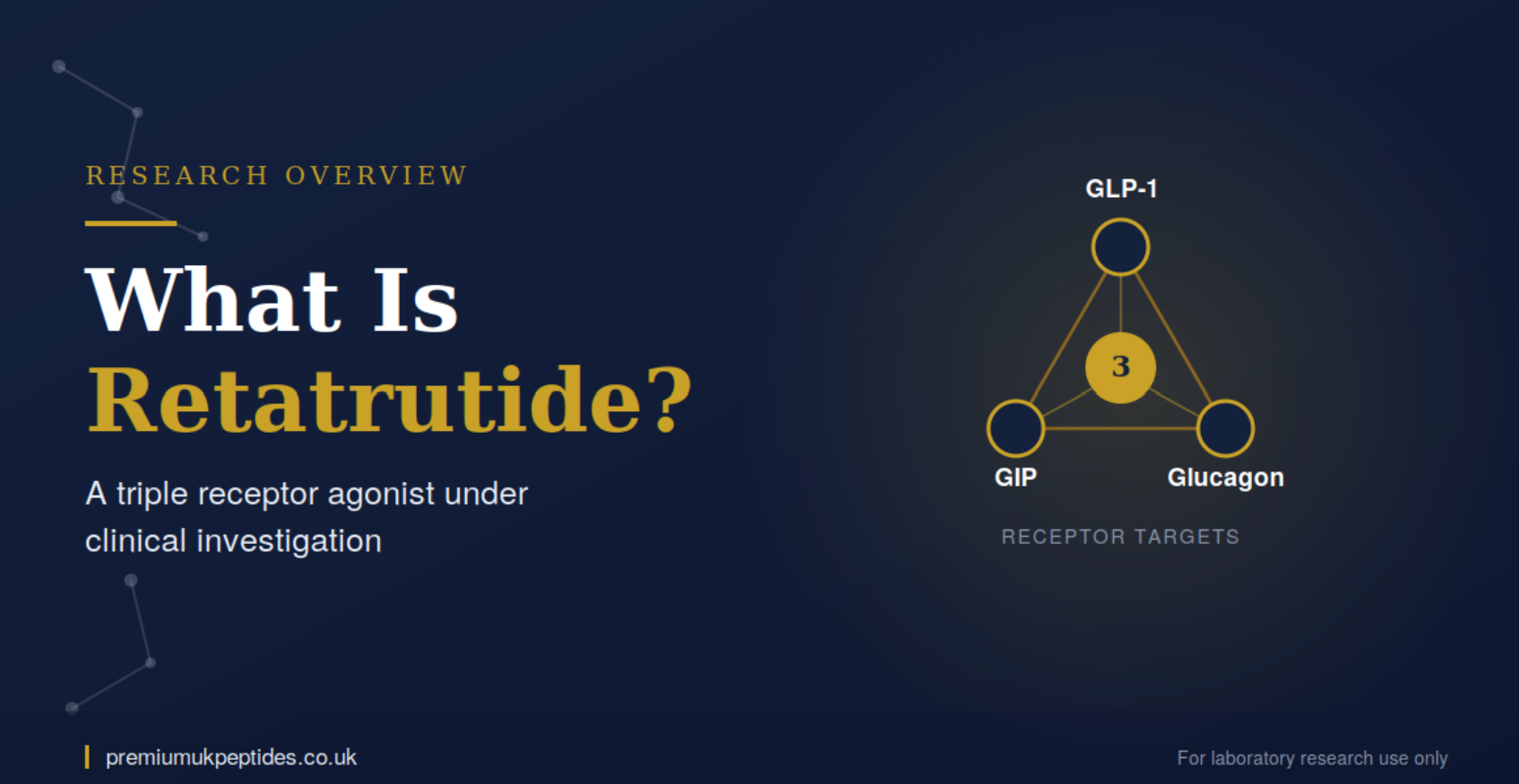
Retatrutide is an investigational peptide that acts on three receptors at once GLP-1, GIP and glucagon. It is currently in clinical trials and is not approved as a medicine in the UK or any other territory.
That triple-receptor action is what makes it distinct from compounds like Semaglutide and Tirzepatide, and it is why Retatrutide has become one of the most closely watched compounds in metabolic research. This article covers what Retatrutide is, how its mechanism differs from related peptides, what published research has examined, and its current regulatory status.
What Is Retatrutide?
Retatrutide, also identified in research literature by its development code LY3437943, is a synthetic peptide developed as an investigational agent by Eli Lilly.
Structurally it is a single-molecule agonist designed to bind three separate receptor targets:
- GLP-1 receptor (glucagon-like peptide-1)
- GIP receptor (glucose-dependent insulinotropic polypeptide)
- Glucagon receptor
This places it in a compound class sometimes described in the literature as a “triple agonist” or “tri-agonist”. It remains an investigational compound and has not received marketing authorisation from the MHRA, FDA, EMA or any other regulator.
Is Retatrutide a GLP-1?
Not exactly — and the distinction matters.
Retatrutide does act on the GLP-1 receptor, so it belongs to the broader family of incretin-based compounds. But describing it simply as “a GLP-1” is inaccurate, because GLP-1 activity is only one of its three receptor targets.
A true GLP-1 receptor agonist, such as Semaglutide, targets that receptor alone. Retatrutide adds GIP receptor activity and glucagon receptor activity on top of it. In research terms, it is a triple agonist that includes GLP-1 activity rather than a GLP-1 agonist as such.
How Does Retatrutide Work?
To understand the mechanism, it helps to look at each receptor separately.
GLP-1 receptor. GLP-1 is an incretin hormone released from the intestine in response to nutrient intake. Its receptor is expressed in pancreatic tissue, the central nervous system and elsewhere. Research into GLP-1 receptor signalling has focused on glucose-dependent insulin secretion and effects on gastric emptying.
GIP receptor. GIP is the other principal incretin hormone. Its receptor is found in pancreatic islet cells and adipose tissue. The role of GIP receptor signalling has been a more contested area of research than GLP-1, with published work examining both agonism and antagonism at this receptor.
Glucagon receptor. Glucagon is generally characterised as opposing insulin, acting on hepatic tissue to influence glucose output. Glucagon receptor signalling has also been studied in relation to energy expenditure and lipid metabolism.
The scientific interest in Retatrutide comes from the combination. Published research examines what happens when all three pathways are engaged simultaneously by a single molecule, rather than through separate compounds. This is the central question the compound was designed to investigate.
Researchers looking to source material for this kind of comparative work can find our Retatrutide UK listing, supplied with full batch documentation.
Retatrutide vs Tirzepatide vs Semaglutide
These three compounds are frequently compared because they sit on the same developmental line each adding receptor targets to the last.
| Semaglutide | Tirzepatide | Retatrutide | |
|---|---|---|---|
| Receptor targets | GLP-1 | GLP-1 + GIP | GLP-1 + GIP + glucagon |
| Class | Single agonist | Dual agonist | Triple agonist |
| Development stage | Approved as a medicine | Approved as a medicine | Investigational — trials ongoing |
Semaglutide was the first of the three to reach approval and targets the GLP-1 receptor alone.
Tirzepatide added GIP receptor agonism alongside GLP-1, making it a dual agonist. It is sometimes referred to by the brand name Mounjaro in its approved medicinal form.
Retatrutide extends this further by adding glucagon receptor activity. Unlike the other two, it has not completed the regulatory approval process and remains investigational.
For researchers, the practical significance is that these three compounds allow comparative study of single, dual and triple receptor engagement within a related structural family.
Independently third-party tested. Certificate of Analysis supplied with every batch. Dispatched from the UK.
View Retatrutide — CoA VerifiedWhat Does the Research Say About Retatrutide?
Retatrutide has been the subject of published clinical trial work, with Phase 2 results appearing in peer-reviewed literature. Five Phase 3 trials have since reported results: TRIUMPH-1 (obesity and overweight with weight-related health conditions), TRIUMPH-2 (type 2 diabetes with obesity or overweight), TRIUMPH-3 (severe obesity with cardiovascular disease), TRIUMPH-4 (obesity or overweight with knee osteoarthritis pain), and TRANSCEND-T2D-1 (type 2 diabetes).
Published trial work has examined endpoints including body weight, glycaemic parameters and metabolic markers across different participant groups. TRIUMPH-1 reported average weight loss of around 30% at 104 weeks; the later-reported trials, conducted in populations with diabetes or cardiovascular disease, reported weight loss in the 21–23% range at the highest doses studied. Results have been reported in the medical literature and trial registrations are listed publicly on ClinicalTrials.gov.
Because this is an active area of investigation, the evidence base continues to develop. Eli Lilly has indicated it intends to submit this Phase 3 data to the FDA for review in early 2027, once manufacturing and quality-control data are finalised. A stated intention to file is not a regulatory decision, and anyone assessing the current state of the research should consult primary sources directly published journal articles and current trial registrations — rather than relying on secondary summaries, including this one.
Is Retatrutide Approved? Current Regulatory Status
No. Retatrutide is not approved as a medicine in the United Kingdom, the United States, the European Union or elsewhere.
It holds investigational status, meaning it is undergoing clinical evaluation but has not been authorised for medical use by any regulator. Eli Lilly has indicated it plans to submit its completed Phase 3 data to the FDA for review in early 2027 but this is a stated filing intention, not an approval, and no regulator has confirmed a review or decision timeline.
This is a meaningful distinction from Semaglutide and Tirzepatide, both of which have completed regulatory review in their approved medicinal forms. Retatrutide has not.
Material supplied for laboratory research is not a medicine and is not supplied as one.
What Published Trials Have Reported on Safety
Published trial reports have documented adverse events and tolerability data, as is standard in clinical research. Gastrointestinal effects have been among the most commonly reported categories in trials of incretin-based compounds generally.
Two points are worth stating plainly. First, safety data from clinical trials relates to the specific investigational conditions, populations and protocols of those trials. Second, because Retatrutide has not completed regulatory review, no regulator has issued a safety determination on it.
For the current evidence, consult the published trial reports directly.
Sourcing Retatrutide for Research in the UK
For laboratory work, the quality of the material determines whether results are meaningful. A few criteria are worth applying to any supplier:
Independent third-party testing. Testing carried out by an external laboratory rather than in-house. Some suppliers test internally only; independent verification is a stronger standard.
A Certificate of Analysis for the specific batch. Not a generic document or a claimed figure, but a CoA corresponding to the batch supplied, showing the actual recorded purity value.
HPLC verification. High-performance liquid chromatography is the standard analytical method for assessing peptide purity.
UK-based dispatch and appropriate handling. Shorter transit times and proper cold-chain handling reduce the risk of degradation before the material reaches the laboratory.
Clear research-use terms. A supplier operating properly will state clearly that material is supplied for laboratory research and not for human use.
We publish a Certificate of Analysis for every batch we supply, and our third-party tested Retatrutide, dispatched from the UK comes with HPLC-verified purity on every order. Our full Certificates of Analysis are available to view.
HPLC-verified purity, batch-specific Certificate of Analysis, same working day UK dispatch.
View RetatrutideFrequently Asked Questions
What is Retatrutide?
Retatrutide (LY3437943) is an investigational peptide that acts as a triple receptor agonist, targeting the GLP-1, GIP and glucagon receptors. It is currently in clinical trials and is not an approved medicine.
Is Retatrutide a GLP-1?
It acts on the GLP-1 receptor but is not a GLP-1 agonist alone. It is a triple agonist that also targets GIP and glucagon receptors.
How is Retatrutide different from Tirzepatide?
Tirzepatide is a dual agonist targeting GLP-1 and GIP receptors. Retatrutide adds a third target, the glucagon receptor. Tirzepatide has completed regulatory approval in its medicinal form; Retatrutide has not.
Is Retatrutide approved for use in the UK?
No. Retatrutide has not been authorised by the MHRA or any other regulator. It remains an investigational compound in clinical trials.
What do published trials report about Retatrutide?
Five Phase 3 trials have reported results TRIUMPH-1, TRIUMPH-2, TRIUMPH-3, TRIUMPH-4 and TRANSCEND-T2D-1 with TRIUMPH-1 reporting around 30% weight loss at 104 weeks and the later trials reporting 21–23% at the highest doses studied. Eli Lilly has indicated it plans to submit this data to the FDA in early 2027, though this is a stated filing intention, not an approval. Trial registrations are listed on ClinicalTrials.gov; consult primary sources for current data.
Where can Retatrutide be sourced for research in the UK?
Look for suppliers offering independent third-party testing, a batch-specific Certificate of Analysis, HPLC-verified purity and UK dispatch. Our Retatrutide listing meets each of these — view the product page to check current availability.
Related: Tirzepatide · Semaglutide · Weight Management research peptides
All products are supplied strictly for laboratory and research use only. Not for human or veterinary use. Nothing on this page is medical advice.